
A trip to Odessa takes you right into the heart of everyday life in a country at war – and, at the same time, brings you into contact with people who face their fears with remarkable resilience. Thomas Prieto Peral, Regional Bishop of Munich, a member of the CPCE Council and head of the South-East Europe Regional Group, visited the Evangelical Lutheran congregation in the city and the surrounding villages in early September 2026, accompanied by Dean Jörg Breu from Regensburg and Dean Wenrich Slenczka from Würzburg. The immediate occasion was the signing of a partnership agreement between the Protestant Deanery of Regensburg and the congregation of St Paul’s in Odessa. On this occasion, Prieto Peral also conveyed greetings from the CPCE.
Even a small scene came to symbolise the journey. During a tour of Odessa, a local guide from the congregation pointed to a hollyhock by the roadside. “It was planted there deliberately,” she explained. Many people plant flowers, “because it gives us strength in this war”. In the city, normality and threat lie side by side: people stroll through parks and sit in cafés, whilst at the same time sirens wail several times a day. The consequences of the Russian attacks are particularly visible at the harbour.
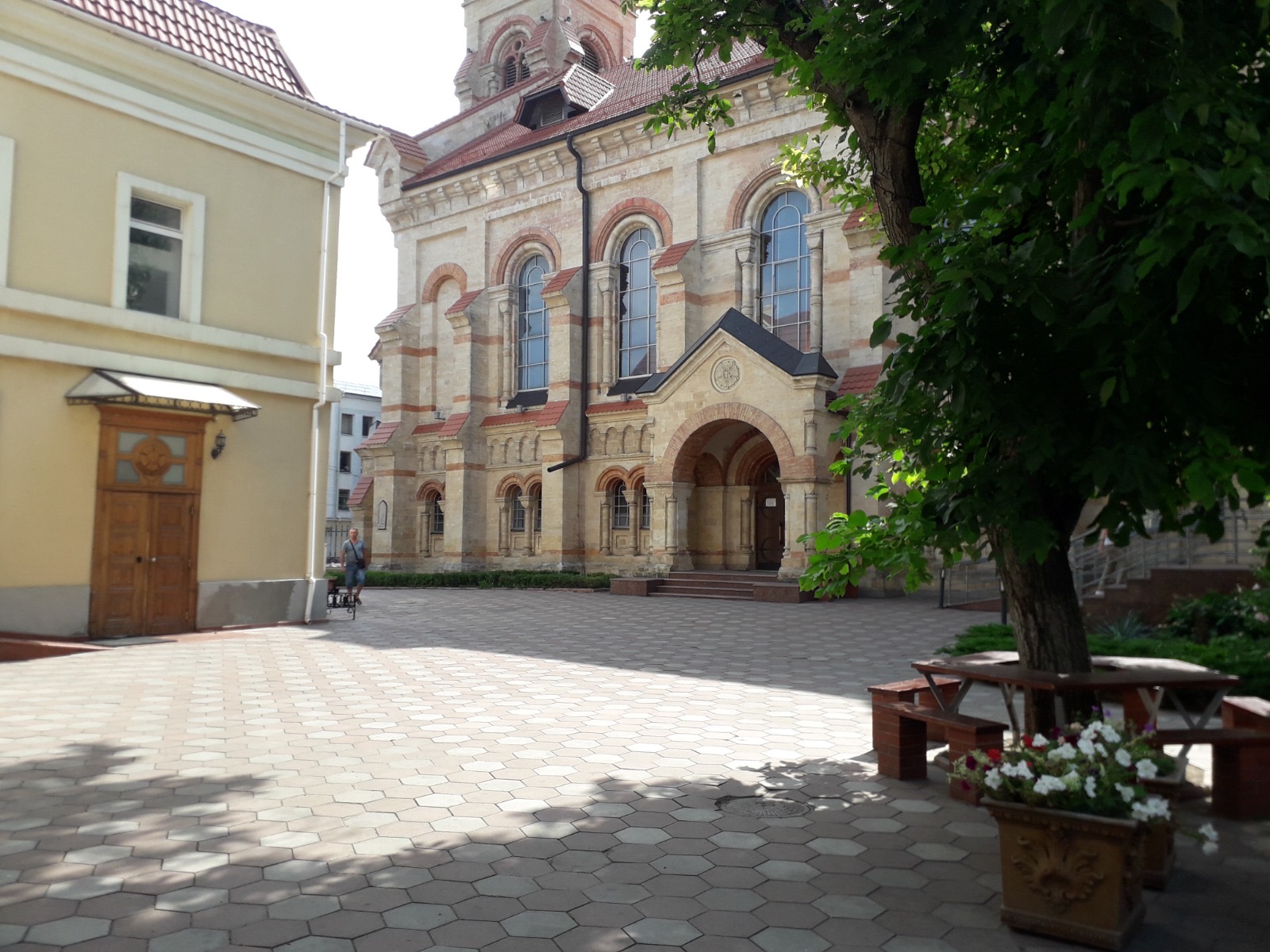
A spiritual centre of the city is the Evangelical Lutheran St Paul’s Church. After decades of disrepair, it was restored and re-consecrated in 2010. The Evangelical Lutheran Church in Bavaria (ELKB) had provided significant support for the renovation. Today, the church is a place of worship, a cultural venue and an oasis in the city. During the visit, an air-raid alarm went off, of all times, right at the start of the service. The congregation did not leave the church but continued to sing, just as they always do during services when an air-raid alarm sounds. The guests’ initial sense of unease gave way to the experience of a service as a ‘celebration against fear’.
The congregation belongs to the German Evangelical Lutheran Church in Ukraine (DELKU). This small Lutheran church now has only around 1,000 members and has been an independent member of the Lutheran World Federation (LWF) and the CELC since 2022. Its roots stretch far back into the history of the German and Lutheran congregations in what is now Ukraine. Following the almost complete destruction of church life during the Soviet era, a process of rebuilding began in 1990.
The ELKB played an important role in this process. Since the early 1990s, it has supported the DELKU through church partnerships, staff secondments, project funding and exchanges. Following a serious internal crisis within the church, cooperation with the ELKB was suspended between 2014 and 2018; it was resumed under the new church leadership of Bishop Pavlo Shvarts. Since the start of the Russian invasion, the ELKB, together with other church partners, has also been supporting humanitarian and diaconal projects in Ukraine.
The link between Regensburg and Odessa also has a special history: the two cities have a political town twinning arrangement, from which church contacts have developed. The partnership, which has now been reaffirmed, is intended to deepen cooperation between the church and the diaconate.
The DELKU is an active member of the CPCE’s South-East Europe Regional Group. At its annual meetings, the DELKU delegate consistently provides compelling reports on the situation of the church.
Just how much ‘hope for the future’ is more than just a phrase was also evident in Novohradkivka, near Odessa. All that remains of the former Lutheran church in the ex-German village of Neuburg are the outer walls. There are now only a few dozen Lutherans left in the village. Nevertheless, the small congregation is planning to rebuild it. For a German property development scheme, this would certainly be a project right at the bottom of the priority list. For the local people, however, it is immensely important: a visible sign of resistance against destruction. Perhaps hope begins precisely like this – with a ruin that one refuses to abandon, a church service during an air-raid siren, or a hollyhock by the roadside.
Thomas Prieto Peral, CPCE Council