At the invitation of the Estonian Evangelical Lutheran Church, synod members from European churches met in Tallinn from 1 to 4 October 2026 to discuss this topic. Although this issue takes different forms across all synods, this meeting yielded something extraordinary.
There was a consensus across borders: something would be missing if the local church were no longer there. With the analytical training typical of most synod members, the working groups discussed topics such as ‘an individualised society’, ‘spaces of communication’ and ‘the language of faith’. One synod member wondered whether the discussions were merely a repetition of what was all too familiar. And of course she was right; nothing was conjured up out of thin air. In keynote presentations, the individual settings in which the transmission of the faith takes place were examined. It happens – or does not happen – within the family, in institutions such as the church, schools or social welfare organisations. Aspects of the Christian faith and way of life are also passed on within the public sphere. Janina Zemanová (Czech Republic), Olga Schihalejev (Estonia) and Marco Batenburg (Netherlands) shared their views on this. By visiting the ‘Kaarli’ School in Tallinn and the ‘Betheli’ social project, the approximately 70 synod members were also able to visit two places that are important to their hosts for the transmission of the faith.
Yet there was still something special about Tallinn – something that the two designated conference attendees, Jennifer Smith and Friederike Krippner, reflected on at the end. According to Jennifer Smith, she had come to Tallinn expecting yet another discussion about the churches’ loss of relevance and the current threats to humanity and faith. But lo and behold: she had sensed a fundamental sense of optimism, along with positive messages and even a spirit of renewal. One only had to listen to Endre Iszlai, the pastor from Debrecen, as he recounted how, Sunday after Sunday, more and more people were coming to his church; or to Seppo Parkilla, the Finnish professor of anatomy, who explained that 80,000 people gathered at the Laestadian Movement’s summer camps. In the border region of Silesia, the local church has set out to establish new congregations. As delegate Mihal Klus reported, this is not a plan or a strategy, but simply something that is happening. The concern that the whole of Europe is caught up in an unstoppable tide of secularisation has also been challenged, as Andreas Hartig, a Transylvanian pastor, was able to testify that Romania is a thoroughly religious country. According to the theologian, one does not have to swim against the tide to be a Christian there.
What made these days so special, therefore, were the personal encounters, which created a positive atmosphere. These encounters helped participants to look beyond their own daily church horizons and to realise: yes, the Church in Europe is not a thing of the past, provided one is open to the vitality of the Gospel.
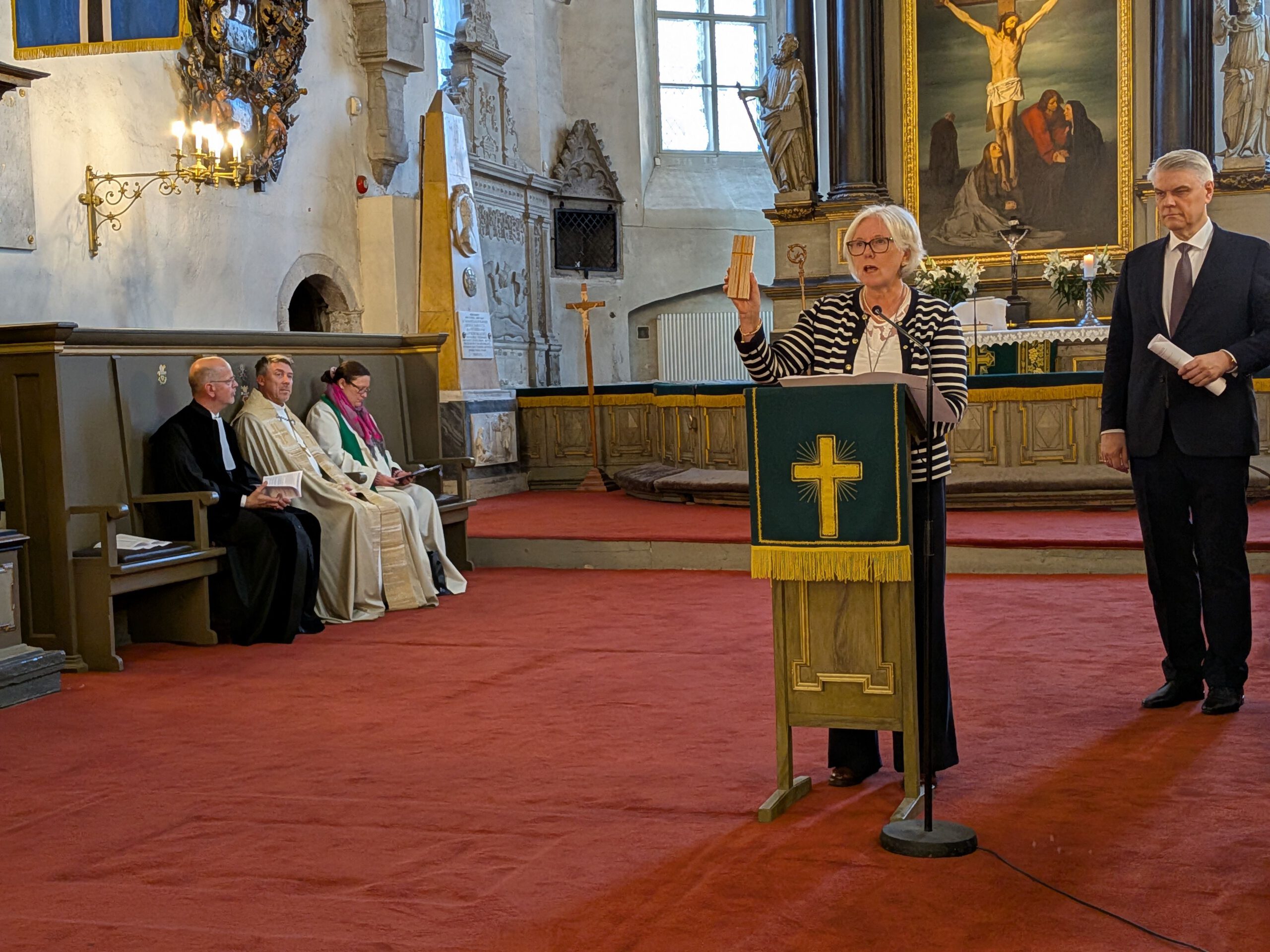
The passing on of the faith during the church services was also made strikingly evident through the passing of the baton between the synodal meetings. The four host churches to date each presented the Deputy President of the Estonian Synod, Judge Priit Kama, with a symbol of their church: from Württemberg came a light cross; from Bern, a miniature of the cathedral; from Budapest, a copy of Martin Luther’s will; and from Baden, a box containing Black Forest figurines and the Union Medal. The Estonian Church added a framed woodcut to these gifts. The intention is not only to pass on the organisational responsibility, but also the spirit of renewal. These symbol now sit in patient expectation at the CPCE’s Head Office, to be packed up, unpacked and passed on again in a few years’ time.