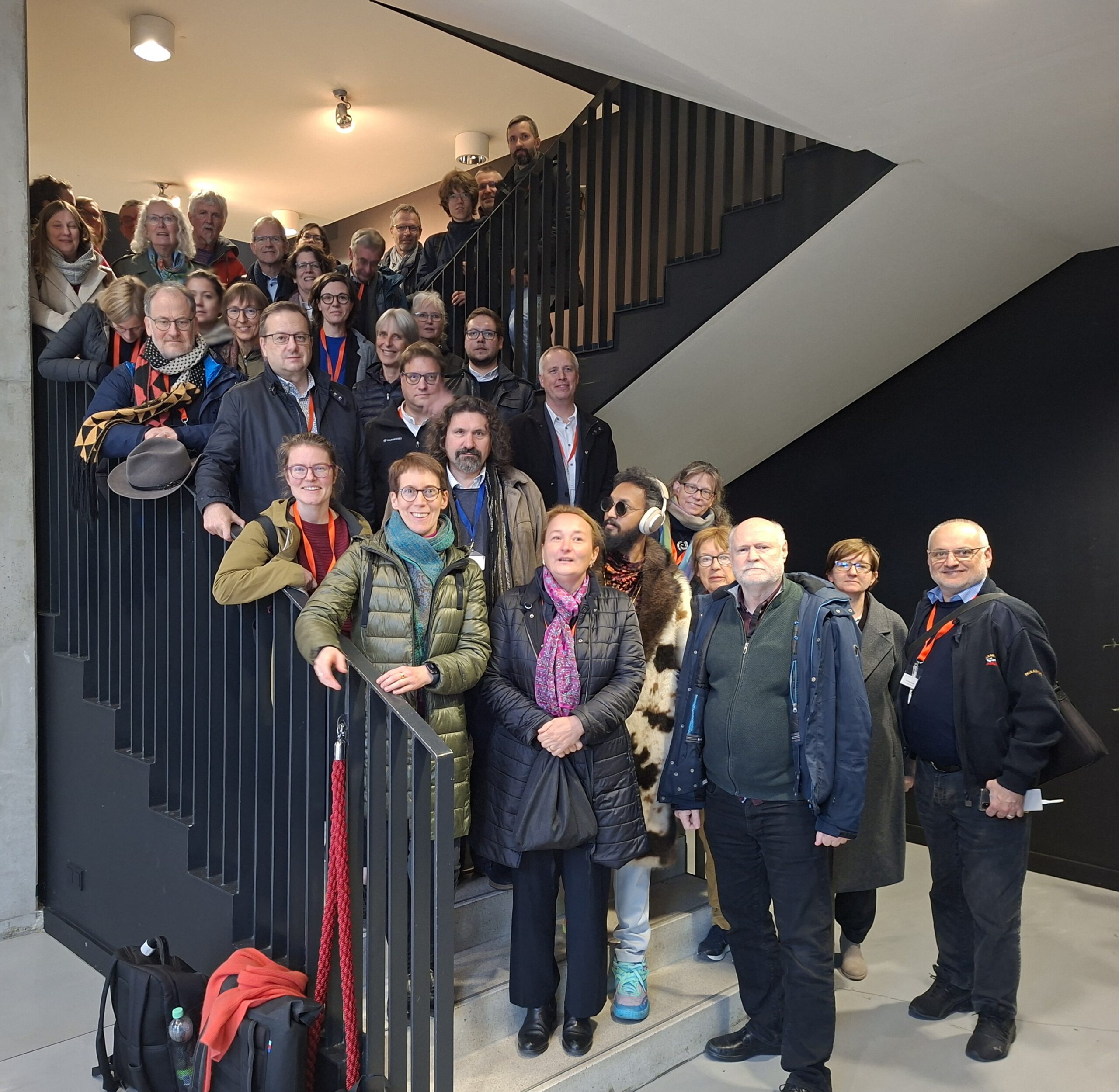
The consultation at the Waldstadion (Deutsche Bank Park). Photo: CPCE.
Protestant churches from across Europe met in Frankfurt to discuss weddings, funerals and blessings.
Vienna/Frankfurt am Main, 7 November 2026. The Community of Protestant Churches in Europe invited its member churches to a consultation on the ministry of European churches at life transitions, held from 2 to 5 November 2026 at the Centre for Proclamation (Zentrum Verkündigung) of the Evangelical Church in Hesse and Nassau (EKHN). The invitation was issued in cooperation with the Evangelical Church in Hesse and Nassau. Experts from 14 countries and 34 member churches attended.
Secularisation Is Not a One-Way Street
The focus was particularly on weddings and funerals. Attention first turned to the people who seek out, attend and organise services locally. Country reports from five regions of Europe with diverse denominational and political backgrounds offered insights into practices in Denmark, France, Great Britain, central Germany and Romania. These reports, together with an analysis by Berlin-based sociologist Daniel Hörsch, provided the basis for discussions over the following days. It became clear that, in the broader picture, the numbers of baptisms and weddings are declining, although many churches have expanded their offerings, for example through baptism festivals and blessing events. The breadth of European perspectives, however, helped to develop a more nuanced view: in Finland, for instance, the number of baptisms has risen significantly. Secularisation is therefore not a one-way street.
Blessing and Choice
The Westphalian theologian and church musician Jochen Arnold outlined a biblically grounded theology of blessing and the act of blessing, thereby illuminating the core of the church’s ministry at significant life events: “Blessings are always free of charge – for all creatures. A blessing is an expression of God’s care, like a red carpet rolled out from Sunday into everyday life.” He thus prompted reflection on the extent to which this aspect could serve as the foundation for a comprehensive ecclesiology, and on what it means to be bearers of blessing in a world at risk. Accounts of practical experience also made clear, however, that blessings must not be bestowed indiscriminately or without being requested. The Hungarian Lutheran pastor Karoly Toth made the point in personal terms when he explained that he would rather bless a life-saving motorcycle helmet than a motorcycle that endangers life and the environment. The Scottish theologian and hymnwriter John Bell, for his part, emphasised that blessings and occasional offices always belong within the context of the body of Christ. They are never merely the actions of individuals but are always embedded in the local Christian congregation. Such rites, according to the Württemberg theologian Henrike Frey-Anthes, have an effect not only outwardly but also within the church. They create a space of resonance rich in blessing.
The Norwegian theologian and chair of the Church Council, Harald Hegstad, also introduced the missionary dimension into the discussion, since blessings and occasional offices are not only about giving but also about receiving. He observed that receiving is no longer something people do unreflectively out of tradition but requires a personal choice: “The necessity of choice also means that participation [in occasional offices] is increasingly becoming an expression of a conscious and personal decision. It is no longer simply something taken for granted because it is customary, but something people actively choose. Thus, paradoxically, the general weakening of ritual tradition may have increased its significance for those who choose to participate.” In a three-way conversation, Christine Oefele (Switzerland), Annette Gruschwitz (Germany) and Stefan Cosoroaba (Romania) grappled with the question of what constitutes the indispensable Christian core of such a rite, enabling a rite of passage to communicate the Gospel at all.
In-Depth Reflections and Outlook
The participants themselves were also able to experience being blessed at an evening Communion service led by their host, Director Peter Meyer, at which Deputy Church President Ulrike Scherf introduced the theme of peace. A small European “song contest” showcased the diversity and beauty of songs from the member churches, which were appreciated as a shared treasure. Morning and evening prayers formed a recurring thread throughout the consultation.
The CPCE’s advisory group on liturgy now has the task of drawing conclusions from the consultation and identifying how work on this subject can be taken forward.
Further information and programme: https://www.leuenberg.eu/de/frankfurt-2026/
CPCE press and resources page: https://www.leuenberg.eu/de/frankfurt-2026/#presse
About the CPCE
The Community of Protestant Churches in Europe comprises 96 Lutheran, Reformed, United and Methodist churches. It represents around 40 million Protestants in Europe and overseas. The church fellowship is founded on the Leuenberg Agreement of 1973. Through this agreement, Protestant churches of different denominations declared fellowship in preaching and at the Lord’s Supper: their members can worship together, and ordained ministers may preach in one another’s churches. The CPCE has been based in Vienna since 2007.
Further information: www.leuenberg.eu
Press contacts:
Dr Stefan Cosoroaba (CPCE)
Email: s.cosoroaba@leuenberg.eu
Jutta Winkler (EKHN)
Email: jutta.winkler@ekhn.de