
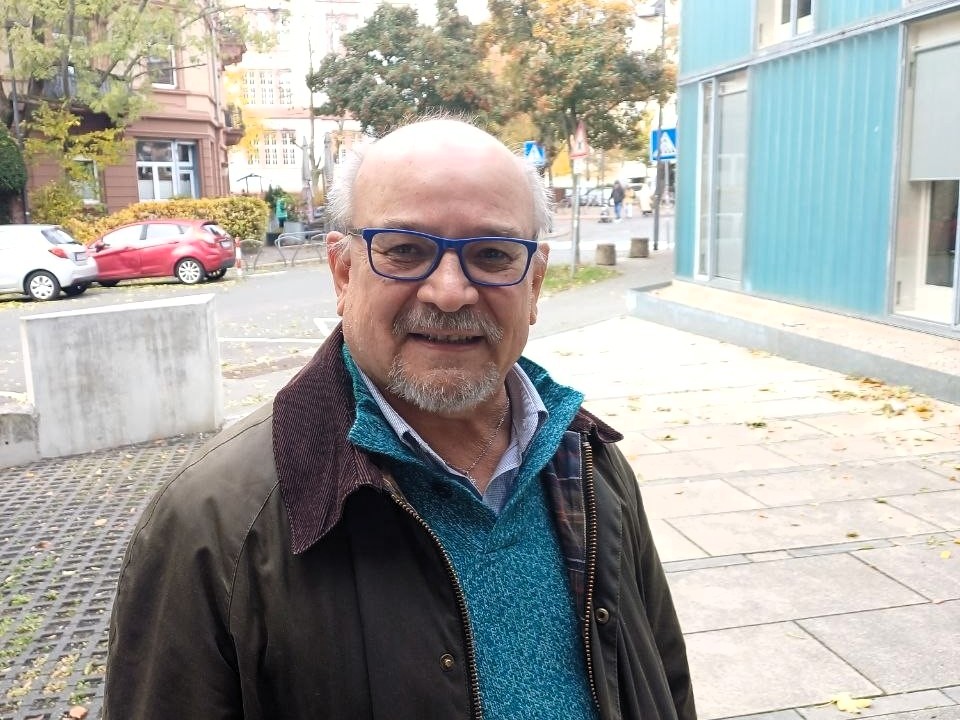
A personal account from the second day of the Frankfurt Worship Consultation. Photo: Kathrin Mette.
On my left sits Annette from Marburg. I have known her since my university days. She is a Methodist. To my right sits Gregorio from Italy. He is wearing a green knitted sweater, has a friendly face, and belongs to the Waldensian Church. I myself am a German Lutheran. Normally, I don't give much thought to my denomination, but things are different here. Since Monday, I have been attending the conference of the Communion of Protestant Churches in Europe (CPCE), along with 40 other participants. We are meeting in Frankfurt am Main and come from various Protestant churches across Europe—not only from Italy and Germany, but also from Hungary, France, Norway, and Slovakia.
Our topic for these four days in Frankfurt is: How do Protestant churches in Europe accompany people at the turning points of their lives—at weddings, at the birth of a child, but also during illness and bereavement? What services and rituals do they offer? Who makes use of them? To what extent do churches respond to people's expectations? And what happens when those expectations are difficult to reconcile with the Church's mission to proclaim the Gospel? On the very first evening, it becomes clear just how different the circumstances of the various churches are. It makes a difference whether we are talking about baptisms, confirmations, and funerals in Denmark or in central Germany.
In Denmark, around 70% of the population belongs to the Evangelical Lutheran Church. Almost one in two people attends at least one church ceremony marking a significant life event each year—perhaps the confirmation of a niece or grandchild, or a neighbour's funeral service. In central Germany, by contrast, only a minority of the population still belongs to a Protestant church. Church weddings and baptisms are rare, partly because in some regions hardly any young people remain. Yet this also presents an opportunity: when a couple does decide to have a church wedding, the congregation suddenly includes many people who have never had any previous connection with the Church.
Today, on the second day, our focus is on "blessing". The programme begins with a lecture entitled "Blessing from Biblical and Systematic-Theological Perspectives". While theologian and church musician Jochen Arnold arranges his notes at the lectern, I chat a little more with Gregorio, the Italian Waldensian sitting to my right. He speaks excellent German, for which I am grateful. I learn that he serves as a pastor in three small Methodist congregations in and around Alessandria, a city of 100,000 inhabitants situated between Genoa and Turin. Fifteen of those inhabitants belong to Gregorio's congregation. "We are few, but we get noticed," he tells me cheerfully. "That's because we are actively involved in social and political issues."
I fetch another coffee for each of us, and then the lecture begins. "What is blessing, and what are we doing when we bless someone?" asks Jochen Arnold. He takes us on a journey from the creation narrative at the beginning of the Bible to the end of Luke's Gospel, where Jesus blesses his disciples before ascending into heaven. "A blessing is an affirmation, not a request. It is a powerful word spoken into the future, a performative speech act," says Jochen Arnold. "Parola performativa," Gregorio writes in his notes. "Blessing follows the logic of an overflowing glass," Jochen Arnold continues. Gregorio writes, "Logica della sovrabbondanza"—the logic of overflowing abundance—and tells me that he has never reflected on blessing in such depth before.
I tell him that, for some years now, churches in Germany have been organising blessing initiatives in pedestrian shopping areas, where pastors offer passers-by a personal blessing. They might, for example, hold up a sign saying something like, "I would like to bless you." And these initiatives have indeed met with a positive response. Some people even interrupt their shopping or errands to accept the offer. "Do you do anything like that where you are?" I ask Gregorio. When he says no, I press him further. "But wouldn't that be a good idea?" He waves the suggestion away. "People would probably call an ambulance and have me taken away," he says. "Religion is a private matter in Italy. It doesn't belong in a pedestrian shopping street." I can't help laughing—both at Gregorio's words and at how different our Protestant churches really are. At the same time, I feel that I have been given a gift, that I have been blessed, simply by being part of this community.
And yes, the feeling is rather like an overflowing glass. How would Gregorio put it? "Logica della sovrabbondanza!"
Rev. Dr Kathrin Mette
Evangelical Lutheran Church of Saxony
Blog: heute-irgendwo.de
Further reports and materials from the Frankfurt Worship Consultation