
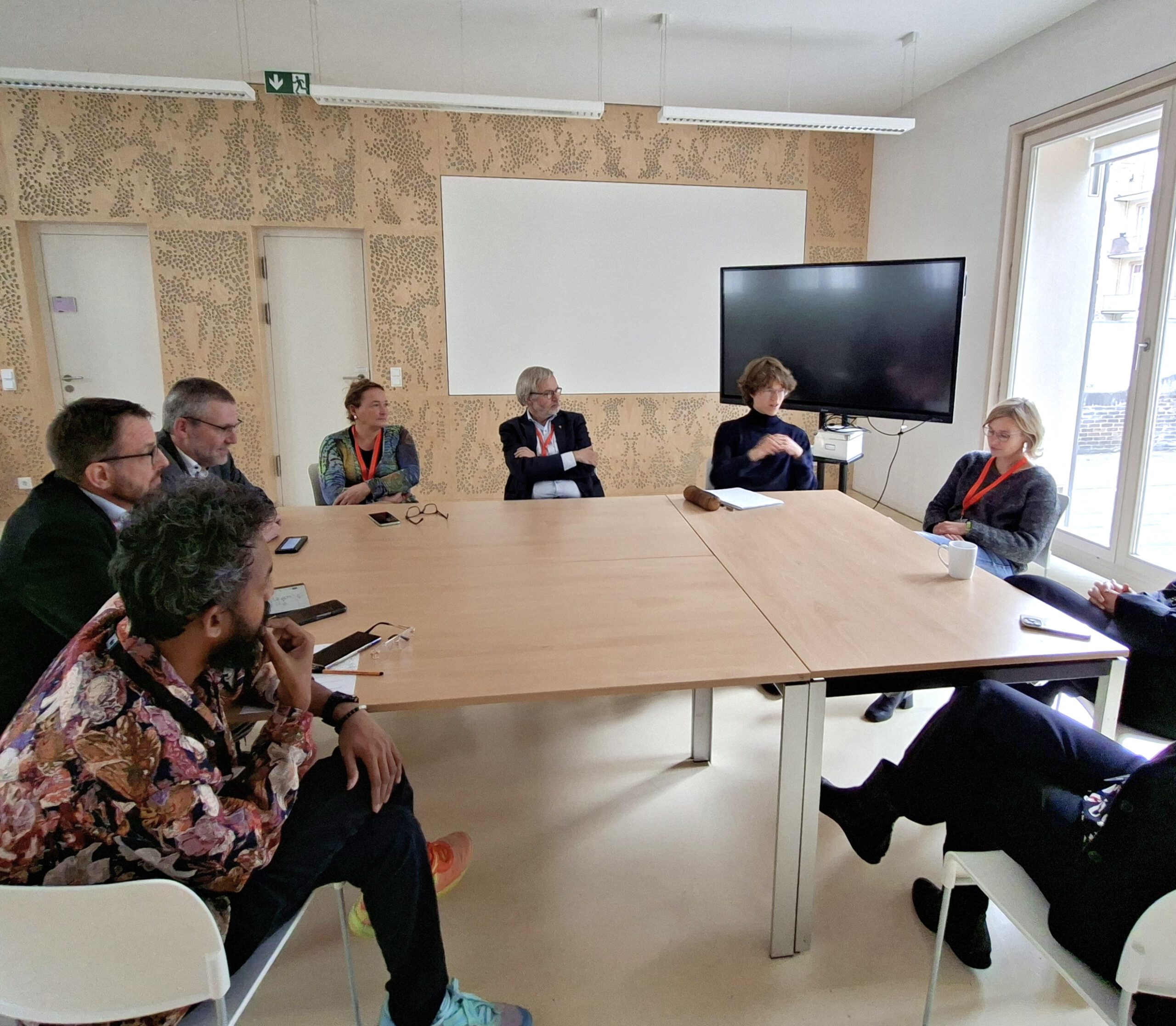
Workshop at the Consultation on Occasional Services. Photo: GEKE.
[Original in German]
The European Consultation on Occasional Services has come to an end. The Amen of the sending liturgy has been spoken. All 43 participants are returning to the places where they live and work, taking different things with them in their spiritual luggage. The following lines describe what is being taken back to Württemberg.
Occasional services are missional
The evaluation of #einfachheiraten (“simply get married”) shows that the initiative is not a means of recruiting new members—and experience suggests that the same is true of other occasional services. Most participants were people who are (still) members of the church, although in many cases they do not feel closely connected to it. In this sense, occasional services are not missional. In another sense, however, they are. It may be that no one joins the church because of an occasional service. Yet we hope that people will remember their connection to the church and find their faith strengthened or renewed.
In this respect, occasional services are “churchy” in the best sense of the word: they make the church visible and challenge us to articulate a clear and recognizable theology, and to act with honesty and transparency. The church places itself at the service of all who belong to it. It becomes visible and welcoming and, through blessing, demonstrates an attitude that translates into action.
Occasional services are expressive
Faith comes from hearing, but not only from hearing. Faith also comes from giving voice to what we believe. By encouraging people to express their hopes, worries, pain, and doubts in their own way and in their own words, occasional services create opportunities to ask questions about faith and put faith into words. But faith also comes from doing. Occasional services offer particular opportunities for participation and, through participation, reflection on what is taking place.
How should occasional services be designed to enable participation and experience, reflection and accompaniment?
Occasional services have an inward effect
Initiatives such as “simply get married,” which are prepared and carried out together as a community, strengthen the church from within—and we need this strength if we are to have an impact beyond the church. First, this happens through the need for theological reflection on the principles that guide our ecclesial and liturgical practice. That is something we are doing together here, too.
Second, it happens through the experience of worship and blessing during the shared preparation and conduct of the day. Those involved locally experienced themselves as blessed. When participants both offer and receive blessings, occasional services become a resonant space rich in blessing.
But this is not always the case. Ministers are often overburdened and working on their own. They experience occasional services as an additional burden in an already overcrowded schedule and have too little time for deeper theological reflection. How would we need to shape everyday pastoral ministry so that the positive effects of occasional services can be felt by those who conduct them? What conditions would need to be created?
Occasional services can speak meaningfully
Liturgical language and liturgical action are particularly fragile and vulnerable in occasional services. At the same time, they aspire to much, for blessing is always also a blessing marked by brokenness. It speaks into people’s fragility and vulnerability, interprets lives that are often fractured in the light of God, and draws people into a community of others whose stories are likewise fragile and who nevertheless—and precisely for that reason—place themselves time and again under God’s blessing. Liturgical language seeks to lead people into community while remaining individual and personal. It gives expression to fragility while also seeking to strengthen. It calls people to responsibility without sounding prescriptive. In occasional services especially, those who lead the liturgy act as witnesses to a faith that has become unfamiliar to many of those taking part. If liturgy is theologia prima, people must be able to understand it on different levels: through words, but also through music, atmosphere, space, and the body. We therefore need liturgical language and a space for liturgical experience that invite people, for the duration of this one service, into the world of faith that we ourselves inhabit.
Which senses do occasional services engage, and how do they open up meaning? Do we pray for people or with them? What do prayers sound like when they leave room for openness and resonance? Do we need a binding and recognizable language of liturgical prayer for everyone, or prayers shaped personally and individually?
Occasional services must be open to questioning
Occasional services seek to accompany people not only at transitions, as rites of passage, but also in many other situations in life. To do so, however, we need to know what people actually want accompaniment with. Occasional services must ask questions and allow themselves to be questioned. The Finnish Church is taking on this task by asking members and employees what they would like from occasional services. It goes further still by seeking to develop contextual, inculturated liturgies together with different ethnic groups within the church. When we sincerely ask people what they want, we learn. We also become more credible. But to do this, we must move beyond our own comfort zone and allow ourselves to be challenged. We must engage with other perspectives and make ourselves vulnerable to criticism. How can this happen in different contexts and cultures?
Occasional services are blessing—but what about the curse?
What unites all occasional services is blessing. We confer this blessing in, with, and under the cross, where the curse of death becomes the promise of God’s living love. How do we think blessing and curse together? In a church that—as studies of sexualized violence in church contexts have shown unequivocally—has itself become a curse to people, and continues to do so, we cannot speak of blessing without also reflecting on the curse. The church is confronted with its own fallibility and must allow itself to be questioned about what this means for its attitudes and actions. The ambiguity of blessing and curse must therefore also be reflected on theologically and liturgically in the context of services of blessing. In view of its failings, how can the church nevertheless pass on blessing? What does such a blessing sound like, how does it become tangible, and how loud, quiet, vulnerable, or accusatory can—or must—it be? How can blessing name the past honestly, give strength for the present, and open up a future?
Rev. Dr. Hendrike Frey-Anthes (Evangelical Lutheran Church in Württemberg)