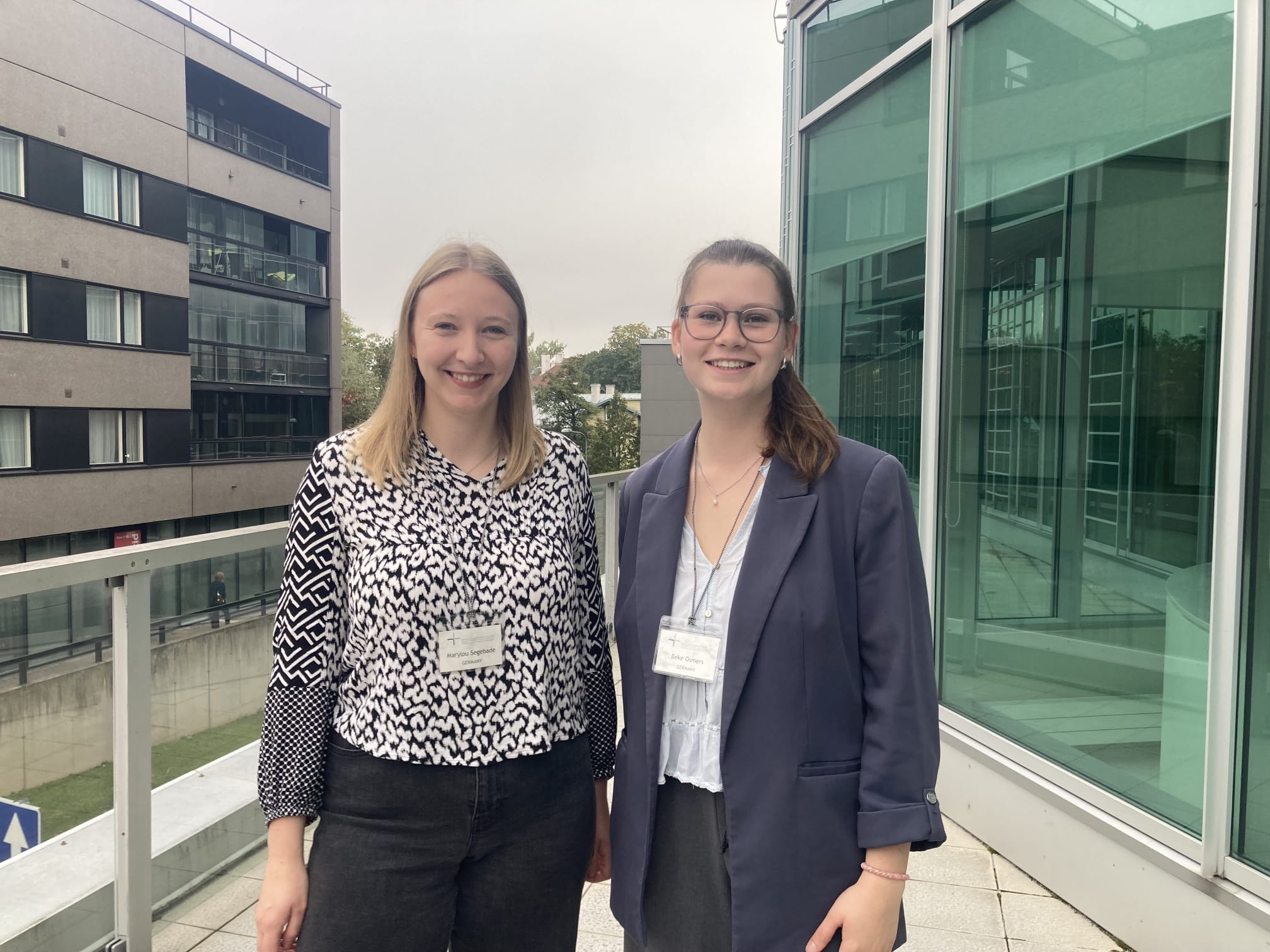
8:30 a.m., Frankfurt Airport. Marylou Segebade and Beke Osmers look out at the tarmac and wait to board their flight to Tallinn. Outside, the last traces of the morning glow are fading from the sky. For the two young women, the meeting in Tallinn is the first international gathering they are attending as synod members.
Marylou Segebade, 25, is vice president of the Synod of the Evangelical Lutheran Church in Oldenburg. She is studying religious education and social work in Hannover and plans to become a deacon. “Passing on the faith to the next generation”—the conference’s theme hits the mark for her. She is looking forward to gaining insights from working with children and young people in other European countries: “Maybe there’s an approach where I realize: Oh, we don’t have that here; we can take that with us.” For this, she’s even willing to overcome her fear of flying.
Beke Osmers, 23, is a trained funeral director and secretary on the executive committee of the Regional Synod of the Evangelical Lutheran Church of Hannover. Like Segebade, she, too, found her calling in the church through work with children and youth. She chose her unique profession when she was still a teenager: “It gives me a lot to accompany people in crisis situations,” she says. She’s taking the conference in Tallinn as it comes—and is also looking forward to getting to know the city.
5:15 p.m., Tallinn Cathedral. The polyphonic and multilingual Communion service marking the opening of the meeting has just ended; Segebade and Osmers are lining up for the group photo. Before the service, there was just enough time for a very brief stroll through Tallinn’s Old Town. What are the first impressions of the two young synod members? They like the city—and the service, conducted in the liturgical tradition of the Estonian Evangelical Lutheran Church, made a strong impression on them. However, some aspects were also unfamiliar to them—for example, right at the beginning, the solemn procession featuring two bishops in full regalia with their miters.
In his sermon on Jesus’ Great Commission in Matthew 28, Archbishop Urmas Viilma acknowledged that the statistics on church life in Europe certainly give cause for concern: “The faith experience of the generation before us has not become an equally meaningful story for our own generation,” said Viilma. “The future for our children and grandchildren has become even more unpredictable.” Jesus’ Great Commission, however, has not changed and has lost none of its relevance or significance—on the contrary: Europe needs the message of the Gospel today more than ever before. What has changed, however, is “the environment in which we try to fulfill it” and “the language and means by which we proclaim the Gospel.”
Marylou Segebade and Beke Osmers belong to the younger generation themselves. Has it become difficult for the church to reach children and young people today? As a prospective deacon, Segebade looks hopefully toward new opportunities to pass on the faith: “Many young people are looking for community, for example in clubs. And they’re also interested in questions about life and faith.” This creates points of connection. “However, many don’t even know what the church has to offer. And the image of the church that many young people have isn’t the image of a modern and diverse church that I experience.” But she certainly sees initiatives that inspire young people as well—and cites examples as diverse as the “Into the Light” worship service, themed “Taylor Swift meets Star Wars,” which will be held this coming Sunday in Oldenburg, or the large regional youth camp in the Hanover Regional Church, which attracts up to 2,000 young people. The church’s digital presence is also important—especially for staying in touch with young people. In Oldenburg, a pastor is specifically assigned to this task; known as the “Elektropastor,” he coordinates digital initiatives.
8:30 p.m. in the hotel dining room. Dessert is ready, and table conversations continue in various languages as people line up at the buffet. Churches from Hungary, Austria, Estonia, and Germany were represented at her table, Beke Osmers explains. By the end of dinner, she now knows not only how old her tablemates are and whether they had teachers or educators who served as role models in their faith. She’s also amazed at how differently synods and committees are organized in the various churches. For now, however, she needs some time to process what she’s experienced—and hopefully a restful night’s sleep.