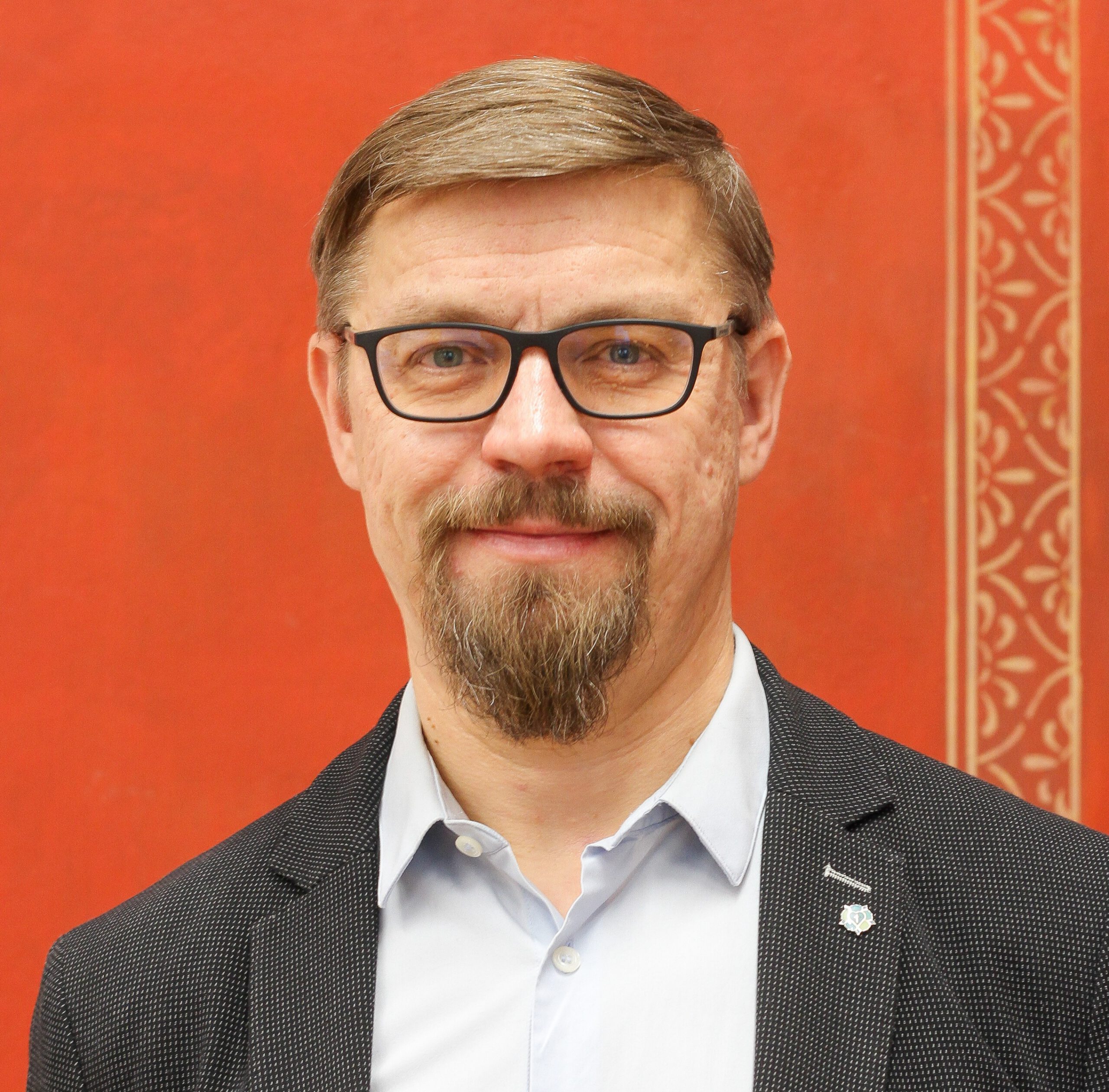
An interview with Prof. Dr Thomas-Andreas Põder, CPCE Study Secretary
This year marks the 20th anniversary of the beginning of your direct involvement in the CPCE context. How did that connection begin?
My direct involvement in the CPCE context began in 2006. At the request of my home church, the Estonian Evangelical Lutheran Church, I wrote a substantial response to the CPCE study text The Shape and Shaping of Protestant Churches in a Changing Europe. In the same year, I took part as a delegate in the 6th General Assembly of the CPCE in Budapest.
There began my work, spanning two terms, as a member of the CPCE Council, which lasted until 2018; afterwards I remained connected to the Council’s work as a proxy member. When the position was advertised across Europe in the summer of 2020, I decided to apply and became the successor of Prof. Dr Martin Friedrich in the CPCE office in Vienna. At the same time, my work on the Council came to an end.
You have been the CPCE’s Study Secretary since 2022. What does your work involve, and what especially inspires you about it?
As the CPCE’s Study Secretary, more precisely as its Secretary for Theology and Ecumenical Dialogue, I coordinate the common theological work and the ecumenical dialogues, contribute to the continuity and further development of the CPCE’s theological self-understanding, represent it vis-à-vis member churches and ecumenical partners, and support the governing bodies theologically.
What inspires me especially is that the CPCE is more than a mere platform for cooperation: it is a concrete form of common Protestant church life in Europe. Here it becomes clear that different confessional traditions do not have to remain church-dividing, but can, in the common understanding of the gospel, come together in a binding, lived church communion in reconciled diversity.
The CPCE is known above all for its theological work. Why are common study processes so important today for the Protestant churches of Europe?
Common study processes are so important for the Protestant churches of Europe today because church communion does not replace common theological work, but presupposes and deepens it. The point is not simply the production of texts or minimal consensuses, but the cultivation, clarification, deepening and further development of the common understanding of the gospel. Precisely in this way such processes serve the common witness and service of the churches.
At the same time, they help to ensure that different confessional traditions are not abolished, but also do not have to remain church-dividing; rather, through common teaching and learning they are brought together toward a bindingly lived church communion.
Doctrinal conversations belong to the core of the CPCE’s theological work. What characterises them?
At the heart of the CPCE’s theological work are its doctrinal conversations. They are complex and long-term processes in which the member churches are involved particularly intensively. Their results are adopted with the highest authority by the General Assemblies and recommended to the member churches for reception. They thus form an important basis for future doctrinal conversations and ecumenical dialogues of the CPCE. Since 1973, seven such doctrinal conversations have been conducted; taken together, they amount to a quite manageable total of around 230 pages.
At the same time, the CPCE’s common theological work is not exhausted by them, but has borne many other important and exciting fruits far beyond that.
One of the major study processes of recent years was “Christian Speaking of God.” What insights do you personally take from that process?
One such example of another form of common theological work was the study process Christian Speaking of God, which I entered roughly halfway through as Study Secretary and then continued to accompany in that role.
What I take from this study process above all is that, for the CPCE, it is a strong sign to reflect together not only on the church or on classical points of controversy, but on God himself. Christian speaking of God belongs at the centre of common theological work because the common understanding of the gospel is related to God as its source, key and point of orientation. For the CPCE, such speech is neither a mere repetition of familiar pious language nor abstract doctrine. It can be intelligible, stimulating and encouraging – while also being critical and self-critical – and can reach people in their concrete life contexts. The study shows how speaking of God can comfort, liberate, reconcile, and encourage people to live within the horizon of justice, peace and hope.
I also find it noteworthy that the 9th General Assembly in Hermannstadt/Sibiu in 2024 explicitly adopted the document and described it as a pioneering contribution to understanding contemporary speaking of God in the CPCE. At the same time, it recommended that the member churches study the document, with its reflections on the conditions, contexts, challenges and ways of Christian speech about God, and take it into account in their own work. It was published in 2025 as volume 17 of the Leuenberg Texts.
Which theological themes will shape the CPCE’s work most strongly in the coming years?
The theological priorities in the common life of our church communion up to the next General Assembly in 2031 were set by the last General Assembly in Hermannstadt/Sibiu. At present, the CPCE is working on several themes, prepared and accompanied in different working contexts, advisory boards and processes. My own focus is above all on the doctrinal conversation Doctrinal Diversity in Church Communion. The point here is neither to trivialise the continuing doctrinal differences in the CPCE nor to treat them again as church-dividing, but to clarify them theologically in the light of the common understanding of the gospel and to make them fruitful for common church life.
So the issue is not simply to describe doctrinal differences. Rather, the question is how such differences are to be understood within church communion, where they can contribute to common learning, mutual correction and a differentiated witness, and where they become a burden. Connected with this is the question of what consequences follow for the CPCE’s self-understanding, for its ecumenical role and for its common public witness.
More generally, the theological themes of the coming years lie where questions of church communion, ecclesial change, and public witness intersect. Alongside the doctrinal conversation on “Doctrinal Diversity in Church Communion,” this includes continued work on the reception of earlier doctrinal conversation results, especially with regard to “Ministry, Ordination and Episkopé” and its relevance for current ecclesial challenges, as well as a theology of change in the face of processes of church renewal, the ethics and practice of agreement and disagreement, peace and war, the handing on of the faith to the next generation, and themes such as being human and migration. Overall, the CPCE is working theologically on how church communion can be lived in a binding way today, further deepened, and credibly witnessed to under the conditions of societal change.
You also accompany the CPCE in ecumenical dialogues. Which dialogues are showing progress, and which are stalling?
With words such as “progress” and “stalling,” some caution is needed in this context, even if one can perhaps speak that way on a superficial level. The CPCE’s ecumenical work is broad in scope. Two official dialogues that are currently especially relevant, and with which I myself am involved, illustrate this well: the dialogue with the European Baptist Federation and the dialogue with the Roman Catholic Church.
Dialogue conversations between the CPCE and the EBF already took place in the early 2000s; since 2010 there has also been an official basis for cooperation in the Agreement for EBF and CPCE to Become Mutually Cooperating Bodies. In 2024, the General Assembly of the CPCE and the Council of the EBF decided to resume the official dialogue. Its aim is to open, on a theological basis, pathways toward a deeper communion and to clarify how steps toward church communion with the CPCE might become possible for individual member unions of the EBF. The first intensive working meeting of the joint dialogue commission took place in Elstal in spring 2026. The focus there was above all on the question of baptism, the search for a viable theological framework for differing understandings and practices of baptism, the different ecclesial structures of the CPCE and the EBF, and the question of what form of a common, ecclesially usable text might correspond to the dialogue. The process is still at a very early stage; at the same time, the first meeting was theologically stimulating, clarifying, and encouraging with a view to the further work.
With the Roman Catholic Church, more precisely with what was then the Pontifical Council and is now the Dicastery for Promoting Christian Unity, there was first a multi-year preparatory series of consultations in the CPCE’s penultimate working period. The final report of that series was welcomed by the 8th General Assembly of the CPCE in Basel in 2018; there, in the presence of Cardinal Koch, both sides expressed their intention to enter into an official doctrinal dialogue. Because of the pandemic and other practical reasons, the actual dialogue meetings could not begin until spring 2022. At the joint interim assessment of the mandating bodies in Rome in December 2025, it became clear that this dialogue had by no means been fruitless: it helped to articulate important theological affirmations more clearly together, to deepen mutual understanding, and to identify the actual points of disagreement more precisely.
At the same time, the joint assessment identified three areas in which no further progress in the existing dialogue format was in sight: first, a different understanding of the process itself – that is, the question whether this is a bilateral format between two church communions or, in view of the different confessional traditions within the CPCE, rather a multilateral one; second, the question with what authority each side speaks for its church or church communion, and which reference texts and criteria of common doctrine are decisive in this regard; third, different models of church unity and church communion, including questions of the visibility of the church and of ministry. On the CPCE side, at its meeting in Doorn at the end of May 2026, the Council aligned itself with the orientation of the mandating parties of 9 December 2025, according to which the dialogue in its existing format should enter a period of moratorium understood as a phase of clarification, reflection, and preparation for a possible continuation. At the same time, the Council specified how this moratorium should be shaped on the CPCE side: with continuing contact with the Dicastery, the preparation of a new meeting of the mandating parties toward the end of 2027 / beginning of 2028, and the task of examining on the CPCE side concrete steps for a constructive and well-prepared resumption.
So, if one wants to speak in simplified terms, I would say: in the dialogue with the EBF there is currently encouraging movement, whereas the dialogue with the Roman Catholic Church has, in its current format, reached a point at which a provisional pause became necessary. In principle, however, ecumenical dialogues are not, for the CPCE, to be measured primarily by whether they achieve short-term “progress” or seem to “stall,” but by whether they serve the truth of the gospel and the unity of the one Church of Jesus Christ by clarifying differences, deepening common church life, and opening perspectives and responsible steps toward lived church communion.
Finally: Which CPCE events, conferences, General Assemblies or dialogues remain especially memorable to you?
What certainly remains especially memorable to me are the General Assemblies of the CPCE in Budapest, Florence, Basel and Hermannstadt/Sibiu. So too the doctrinal conversation process Church Communion with the consultation of member churches in Elspeet (Netherlands) in 2015, the study process Christian Speaking of God with the consultation in Bad Vöslau (Austria) in 2022, and also – in a very positive way – the encounters in the dialogue with the Dicastery for Promoting Christian Unity in Paris in spring 2023 and with the European Baptist Federation in Elstal (Germany) in spring 2026.
Even more important to me, however, is what all this shows: that we do not understand the life of our own church, and also of our own local congregation, as something standing on its own, but as a life that we live together with other churches and before God. The CPCE is for me, as I have said, not simply a platform, an umbrella or a network, but a concrete form of common Protestant church life, in which different confessional traditions are not abolished, but can be deepened and newly understood from the perspective of the gospel precisely in common church life. Perhaps that is the most important thing the CPCE has shown me over the years: that Protestant ecclesial life corresponds to its own truth only when it is not self-sufficient, but opens itself toward a bindingly lived church communion.