The Protestant Church in the Netherlands is a broad, ecumenical national church, the largest Protestant church community in the Netherlands, one which is grappling with a continuing decline in membership whilst at the same time seeking renewal through pioneering projects and missionary initiatives
Basic information
Official name of the church: Protestantse Kerk in Nederland (PKN; Protestant Church in the Nederlands)
Number of members (approx.): 1.387.000
Number of congregations: 1.458
Number of ordained ministers: 1.352
Structure & organization
Church leadership:
Rev. Kees van Ekris, scriba (generale secretary)
Rev. Trijnie Bouw, moderator of the general synod
Church constitution/structure: Presbyterial-synodal
Social presence
Important areas of work
The church plays an important role in society through its diaconal and social care work — food banks, refugee reception, care for the elderly
Role in society
Historic national church, but the nature of the PKN has changed due to rapid decline in membership.
Contact & media
www.pkn.nl
Inquiries: info@protestantsekerk.nl
Further questions:
- Position & Unique Features
“How would you describe the position of your church in your country or region?
The PKN was formed in 2004 following the merger of the Evangelical Lutheran Church, the Reformed Churches in the Netherlands and the Dutch Reformed Church. The Reformed Church was a ‘national church’, but the nature of the PKN has changed due to rapid decline in membership.
The Netherlands is one of the most secularised countries in the world. The majority of the population no longer has any religious affiliation. Around 2020, for the first time, more than half of the Dutch population stated that they had no religion.
Churches and religious organisations enjoy freedom of religion and organisation in the Netherlands, but are not given preferential treatment over other civil society organisations. The separation of church and state is a fundamental principle.
The church still plays a role in society through its diaconal and social care work — food banks, refugee reception, care for the elderly — and thus makes a visible contribution to society. In addition, in the Netherlands, specialised (Christian) education is constitutionally on a par with state education, and churches are often involved in Christian education.
- Current Challenges
“What are the current challenges your church faces in its work or area of activity?”
Membership decline and an ageing congregation
Over the past 10 years, the number of registered members has fallen by almost 30 per cent — from 1,970,000 to 1,387,000. The average annual loss amounts to over 58,000 members. The average age of registered members is 53.
Discussion on ministerial roles
For some time now, the church has been reflecting on the position of pioneers (who wish to administer baptism and the Lord’s Supper in small pioneer communities but are not authorised to do so) and the situation of church workers who often serve in small congregations. In future, a university degree will no longer be required for ordination; instead, a person with a qualification at a university of applied sciences (ba) may also be ordained.
Pioneer groups: promising but vulnerable
Since 2005, the PKN has been developing pioneer groups — new ways of being a church for people who do not (or no longer) attend church. More than 180 have now been set up. On 1 January 2024, there were 99 active pioneer groups. The number of new sites grew rapidly from 2013 to 2017, but growth levelled off thereafter. Financial sustainability remains a persistent challenge: pioneer sites are dependent on external funding and struggle to sustain themselves.
Organisational structure and administrative reform
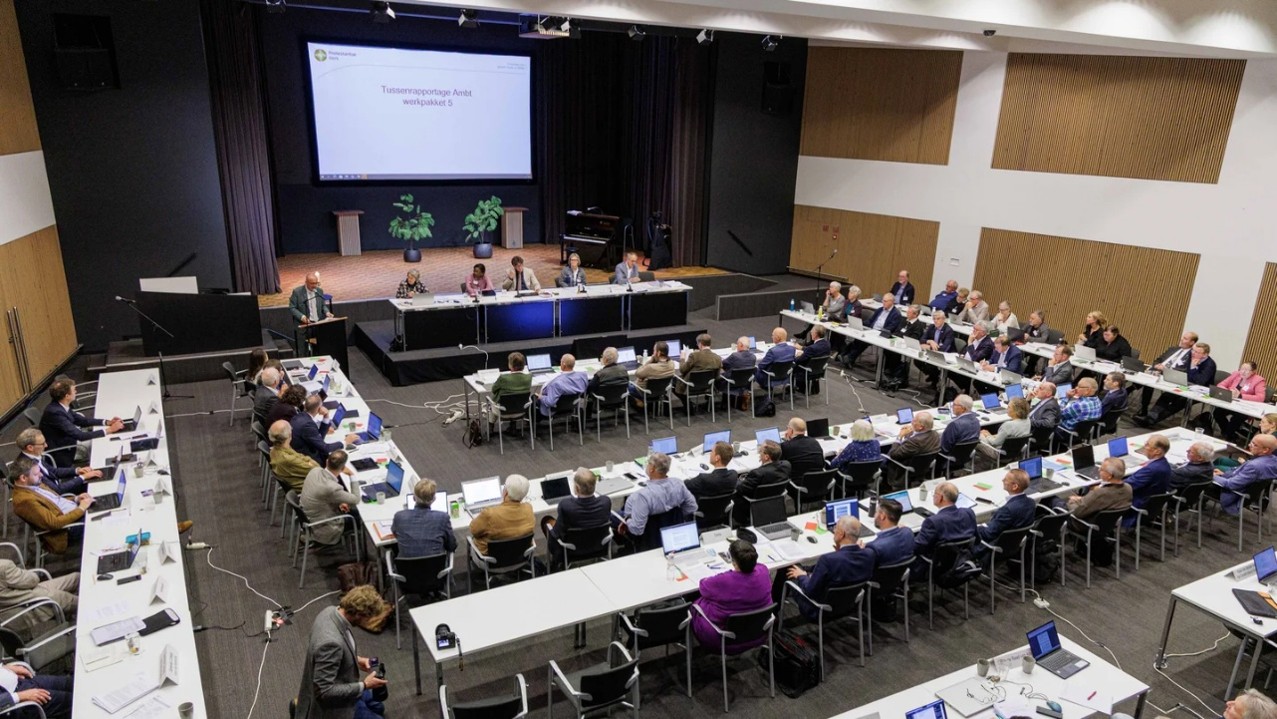
One of the greatest challenges is finding a new balance between central and local structures. Local congregations must be able to retain their autonomy without losing the cohesion of the PKN as a whole. In addition, questions arise such as: how can more young people be involved in governance, and how can the church remain open to new ideas whilst staying financially sound?
Church closures
Church closures appear to accelerate the trend of people leaving the church: when a church closes its doors, many parishioners simply give up. It is difficult for them to take the step of moving to another church building. At the same time, closure is financially unavoidable for small congregations.
- Best Practices / Successful Initiatives
“Can you provide an example of a particularly successful initiative or practice in your church that you consider a best practice?”
The PKN deliberately opts for formats that appeal to people outside the traditional church structure — via television, social media, or a local congregation. In doing so, the church demonstrates that it can remain relevant without relying solely on the familiar Sunday service as its only format.
The Passion
One notable national initiative is The Passion. It is a musical retelling of the Gospel, using modern music and contemporary lyrics. Last year, The Passion reached 3.2 million people via television; 200 congregations watched it together with parishioners and local residents; and nearly 9 million people viewed the online content via social media. Research has shown that, for many viewers, The Passion has given the biblical story a new or different meaning.
Pioneering communities
At a local level, pioneering communities represent an important innovation. The PKN has been developing pioneering communities since 2005 — new ways of being a church for people who do not (or no longer) attend church — and since 2012, structural provision has been made for this. More than 180 such communities have now been established.
A key principle of successful pioneering is ‘listening to the context’: being open to the local area, finding out who lives there and what issues are at play. It is also essential that people from the target group themselves become co-owners of the pioneering community.
- Significance of GEKE Membership
“What does it mean for your church to be part of the Communion of Protestant Churches in Europe (GEKE), and how does this membership affect your work?”
The PKN participates in several ecumenical bodies. Membership of the CPCE is important because of the PKN’s history, in which the Reformed and Lutheran traditions come together.
The church constitution also attaches great importance to the ecumenical calling: “The church is called to seek and promote unity, fellowship and cooperation with other churches of Jesus Christ. The church participates in and encourages ecumenical work in the Netherlands and throughout the world (…).”
The publications produced by the CPCE are consulted and used in the PKN’s policy-making.