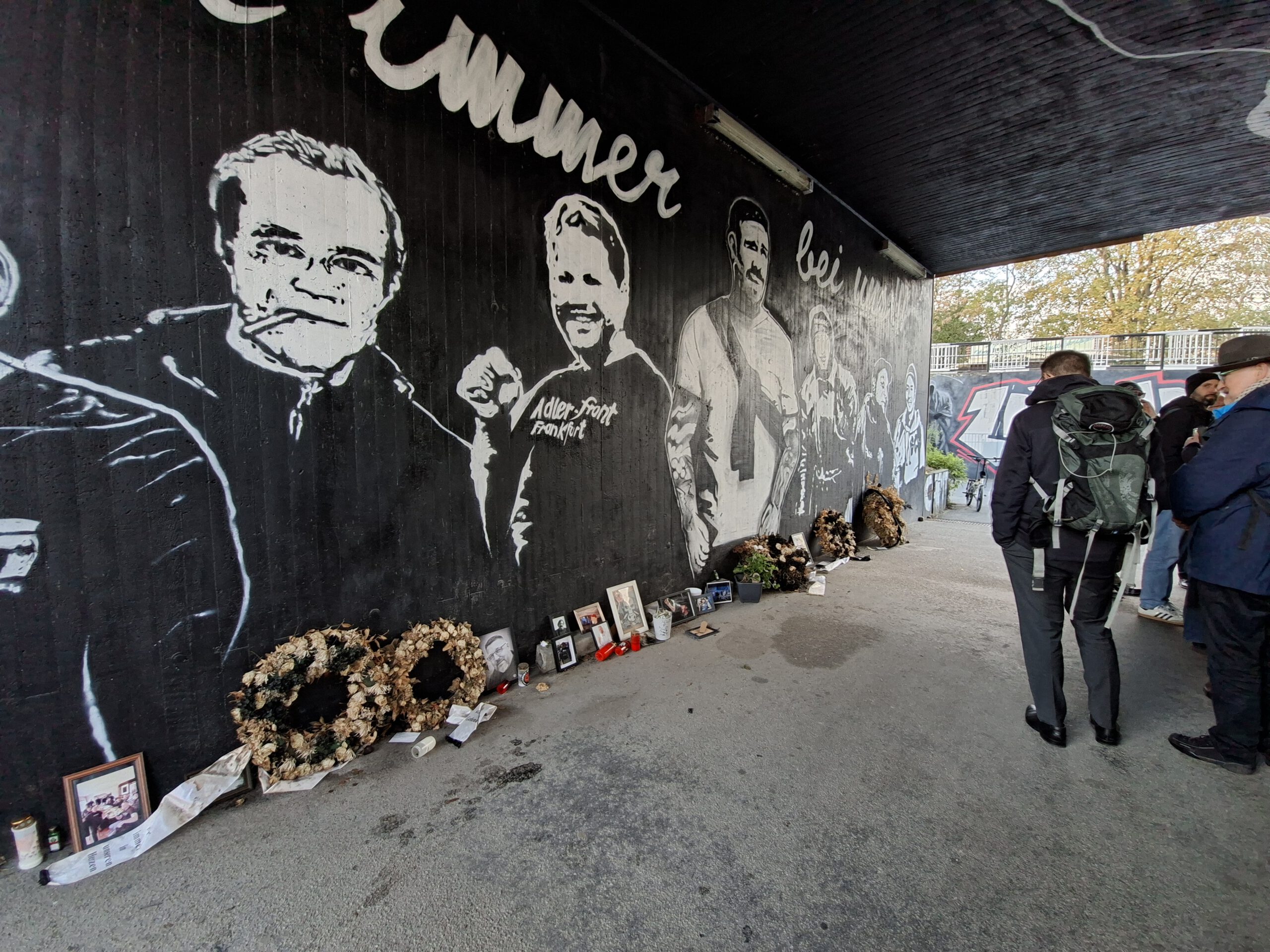
A report from the Frankfurt Worship Consultation. Fan memorial near the Frankfurt stadium. Photo: GEKE.
The visit to the stadium begins beneath a railway bridge. It is cramped and somewhat chaotic, with the noise of passing trains and nearby construction work repeatedly interrupting us. Here, Pastor Peter Noss draws our attention to the graffiti covering the walls and ceiling of the underpass. It depicts people in black and white, with the words “Forever Unforgotten” above them. Several wreaths lie on the ground. Pastor Noss explains that this is a place where members of the fan community commemorate those who have died.
A special place on the ceiling is reserved for a special fan: Helmut Sonneberg, a Holocaust survivor and long-standing representative of the club who was actively involved in its fan community for many decades. He died in 2023, and the image now commemorates his life and dedication to the football club. His portrait can also be found elsewhere, on a banner on the outside of the stadium, through which Eintracht Frankfurt expresses its commitment to remembrance and its opposition to racism. Remembering the dead and sharing common values are part of fan culture.
The way to the stadium chapel leads through the VIP entrance. There we find a long, windowless room with concrete walls. We sit down on red-and-black metal chairs. As there are so many of us, a grey sofa in one corner and several folding chairs are also pressed into service. The words “Faith Meets Passion” are projected onto the wall. At the front stand an altar, a lectern and a baptismal font, all made of wood. The furnishings of the chapel, which opened in 2007, were designed by the late artist Werner Pokorny. Today, four pastors are responsible for the chapel’s activities, volunteering their time alongside their regular pastoral duties. Two of them, Peter Noss and Markus Schnepel, are here today to tell us about their work.
We are visiting as part of a liturgy consultation, so it is fitting that the two pastors explain the liturgy of a football match, known in the stadium as the “choreography”: the countdown, the stadium anthem “Mitten in Europa” (“In the Heart of Europe”), and the enormous banners unfurled over the supporters’ sections. Yet the ritual sequence of a home match actually begins much earlier. Two hours before kick-off, the streets are already filling up and fans make their way to the stadium together. Before heading to their usual seats, they have bratwurst and beer. Even the use of pyrotechnics, prohibited because of the risk of injury, somehow forms part of the choreography.
Is the stadium chapel part of this football liturgy? At present, Noss and Schnepel tell us, that is not yet possible. The chapel remains closed during home matches. Instead, it is used at other times: Eintracht fans regularly ask to be married at this place that means so much to them, or to have their children baptised there. For them, receiving God’s blessing here, in the stadium itself, is something special. Groups preparing for confirmation, both Catholic and Protestant, also regularly visit the chapel, just as we are doing today.
The stadium chapel in Frankfurt is not the only one in Germany. The team has travelled to various locations to learn about their different approaches. In fact, the points of contact between Christianity and the German Bundesliga all operate somewhat differently. There are also chapels in Gelsenkirchen and at Berlin’s Olympic Stadium, for example, where services of devotion are regularly held before home matches. In Leipzig, a chapel is run by Christian supporters’ groups. And in Bochum, the “Fan Cathedral” (“Fan-Dom”) has recently opened: a Protestant church that welcomes visitors on home-match days. There, the regional Protestant church even funds part of a post dedicated to stadium chaplaincy, while the football club provides the necessary access. This service is now regularly used during Bochum’s home matches. The Frankfurt team hopes to build on its connections with these other places of Christian life in football stadiums to develop its own work further. One major goal is to establish a presence at home matches in the future. Other areas of interest include cooperation with Catholic colleagues and perhaps even interfaith initiatives. A Jewish supporters’ club already exists, as does a Christian–Jewish football podcast, and Peter Noss hopes that Christian–Jewish–Muslim cooperation will become part of fan culture in the future.
At the end of our visit, Markus Schnepel shows us the closing ritual he uses when groups of young people come to the chapel. Having “kicked” God’s word out into the world in this way, we conclude our visit with a group photo and a brief look at the pitch at the heart of the stadium.
Matti Schoss (CPCE Young Theologians)
Further reports and materials from the Frankfurt Worship Consultation