
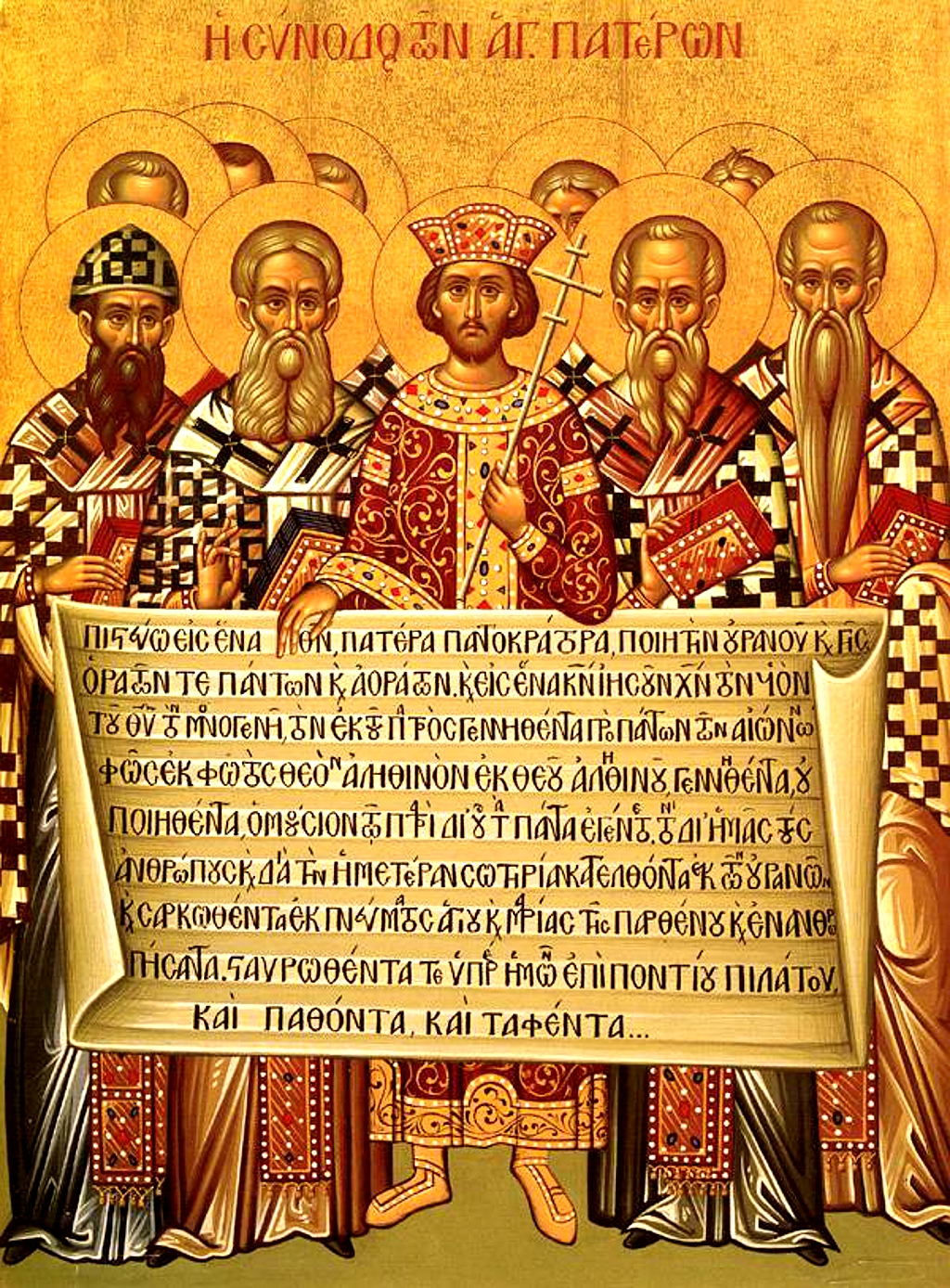
In 2025, the 1700th anniversary of the Council of Nicaea has been celebrated in many places in the form of academic conferences and church commemorative events. We, as the Communion of Protestant Churches in Europe (CPCE), would also like to join in the general celebrations, because we owe a great deal to the Council and its decisions. The Council of Nicaea succeeded in formulating a confession of faith that states our belief in one God — the Father, the Son, and the Holy Spirit — as an expression of the biblical witness. For us today, the significance of the Council lies primarily in three areas: the doctrinal confession of faith by the Council, the role of political power in church matters, and the establishment of a common date for Easter. In the following, we would like to examine each of these points in more detail and assess them in the light of the Leuenberg Agreement, the foundational document for the CPCE.
1. The doctrinal confession of faith
We are aware that the doctrinal confession of faith 325 did not initially lead to the pacification of the intense dogmatic disputes of this era, but we are grateful that it has been possible to approach the biblically attested mystery of God’s incarnation with the help of the philosophical concept of homoousios. Consequently, we see in the confession of 325 the basis for a development that, in the course of the 4th century, led to the formulation of the Nicene-Constantinopolitan Creed, which is widely received ecumenically today.
The Leuenberg Agreement deliberately places itself in this doctrinal tradition (LA 4 and 12), following Reformation theology, which explicitly linked itself to the Creeds of the early church. We are convinced that this connection was not based on unreflective traditionalism, but rather on the theological insight that the doctrine of justification implies the doctrine of the triune God (LA 8).
The formulation of the Trinitarian belief in God was an innovative breakthrough in thinking about God, which remains highly relevant today, especially in view of the widespread thinking that declares belief in the triune God to be an unnecessary difficulty. The Christian concept of the Trinity is constantly being questioned especially in encounters with other religions and is often difficult to communicate in the secular world. We therefore take the anniversary of the Council as an opportunity to recommit ourselves to the central confession of faith in Jesus Christ and the triune God with their salvific significance as it is highlighted in the formulation “for us and for our salvation”. We commit ourselves to find new and fresh forms of expression to share the truth of this confession with today’s world on our shared journey of confessing.
The later omission of the Nicene anathemata teaches us that bearing witness to the true faith today cannot be done through exclusion or condemnation, but through a reconciled diversity in confessing, as the Leuenberg Agreement has helped us to understand.
2. The role of political power
We are aware that the role of Emperor Constantine at the Council of Nicaea is viewed by some very critically and that his influence on the theological deliberations of the Council is considered far too extensive. There is no consensus on what influence the emperor actually had on the results of the Council.
Throughout history, Protestant churches have also benefited from political forces taking responsibility for church order. If there are approaches today that seek to portray the emperor as a model of a Christian system of rule in harmonious unity between ecclesiastical and political power, then we distance ourselves decisively from such approaches: neither should political powers be theologically exaggerated, nor should churches be instrumentalized by political powers. Today, we consider it to be one important task of the state to guarantee freedom of religion or belief.
We say this not least in a spirit of self-criticism with regard to our own Reformation traditions, which in some cases made use of the authorities to get rid of theological opponents. Among these opponents were, in particular, those who could not support the Nicene Creed and were therefore forced to emigrate or were executed. Here, we as the CPCE stand for a completely different understanding of witness and service, which is committed to “the struggle for of justice and peace” (LA 36).
3. A common date for Easter
We are aware that it is not entirely clear historically to what extent the establishment of a common date for Easter can be traced back to the Council of Nicaea. However, we regard the decision itself as a milestone that can and should remind us even today of our common ecumenical responsibility. Today, Christians celebrate Easter on different dates, depending on whether they follow Eastern or Western church calendars. Even within our own Protestant church communion, some churches in the Orthodox environment celebrate according to the Eastern date.
The Leuenberg Agreement states that “true unity of the Church is [achieved through] agreement in the right teaching of the Gospel and in the right administration of the sacraments” (LA 2). It also states that “we cannot separate communion with Jesus Christ in his body and blood from the act of eating and drinking” (LA 19) and that “the preaching of the churches gains credibility in the world when they give a united witness to the Gospel” (LA 36). The Leuenberg Agreement therefore challenges and encourages us to work towards ensuring that Easter is once again celebrated on a common date throughout Christianity in the future.