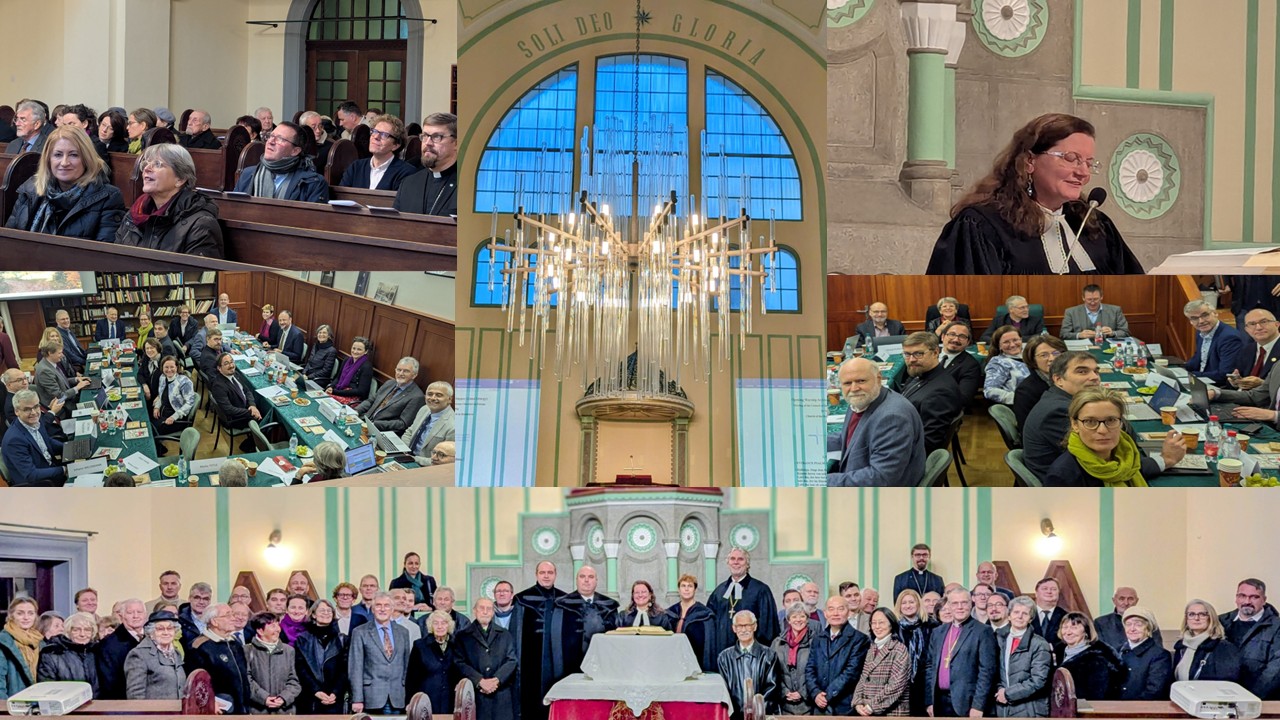
When the Lord’s Prayer is prayed in different languages and familiar hymns, Bible texts and sermons are heard in different European languages, one gets a sense of what is meant by the CPCE spirit. At the Council meeting in Bratislava, which brought together around 30 people from 13 different countries, one of the CPCE’s main concerns, namely to celebrate worship across denominational, cultural and linguistic boundaries, became tangible.
The Evangelical Church of the Augsburg Confession in Slovakia and the Reformed Christian Church in Slovakia (both CPCE member churches) – minority churches in a predominantly Catholic country – acted as host churches, helping to prepare the council meeting, organising the worship service, providing the meeting facilities, and organising a city tour and dinner with a folk singing group. We are grateful for the detailed preparations and the smooth running of the event!
Working topics in the internal church field as well as democracy and social engagement
The opening topic of the Council meeting contrasted with the pleasant atmosphere: the humanitarian and security crisis in Europe triggered by the war in Ukraine. Council members from countries bordering Russia and Ukraine reported on aid projects for refugees, hot meals, joint activities and educational opportunities, but also on how society is preparing for a state of defence.
Another topic that took us out of our comfort zone was the long-term financial situation of the CPCE. It was decided that in future, membership fees would be adjusted to the number of church members and the purchasing power index in each country. The minimum contribution of €300 will remain in place for churches with up to 20,000 members.
The ‘theology of change’ addresses the challenges facing churches in Europe, seeking answers to social, financial and personnel-related changes. The Council dealt with this work process as well as with the upcoming consultation on ‘Ministry, Ordination and Episkopé’. The CPCE’s doctrinal discussion of the same name was published as a book several years ago. The re-reading will focus on the changed situation with regard to the shortage of pastors and new opportunities for entering the pastoral ministry, as well as the role of ordained women (especially in leadership positions in the church).
Furthermore, the Council received reports on the development of the doctrinal dialogue on doctrinal diversity in the church community and on the dialogues with the Roman Catholic Church and the European Baptist Federation, and discussed the progress of these processes.
The working area ‘Church Communion and Migration’ goes beyond denominational differences: the European church landscape is becoming increasingly diverse as numerous believers from different parts of the world bring their churches to Europe. In some European countries (such as France), Christian interculturality is an important field of work. The CPCE Council decided to identify the churches originating from migration with which the next exploratory talks will be held.
The issue of democracy in the polarisation between pluralism and populism remains a challenge for Europe. The Council decided to submit another EU grant application for the development and dissemination of the ‘Democracy Compass’ (working materials for member churches).
Rev. Enno Haaks, General Secretary of the Gustav Adolf Werk (GAW), presented to the Council the church aid projects that the GAW has carried out for the CPCE over the past six years. The money comes from the Italian cultural tax Otto per Mille of the Evangelical Waldensian Church. Almost one million euros have been invested in educational and social projects in CPCE member churches and the Fellowship of Middle East Evangelical Churches (FMEEC). The focus was on projects in seven European countries for children affected by their parents’ labour migration (‘Euro orphans’).
The Council adopted a statement on the 1700th anniversary of the Council of Nicaea, which will be published on 27 November 2025.
Next General Assembly in 2031 and personnel changes
As several ecumenical assemblies are already planned for 2030, the CPCE Council has decided to hold the next General Assembly in 2031 in order to conserve the resources of the member churches. The location is still to be decided. In order to promote diversity, the General Assemblies are always held in different European regions. Southern France with neighbouring northern Spain or the Baltic Sea region are being discussed as possible locations for the next General Assembly.
This was the last regular Council meeting for General Secretary Mario Fischer. Acting President Rita Famos thanked him for his great commitment. Designated General Secretary Susanne Schenk attended the meeting as a deputy council member and impressed with a devotional on the morning hymn ‘All Morgen ist ganz frisch und neu’ (Every morning is fresh and new), which she interpreted in terms of its significance during the Reformation and in 20th-century European ecumenism.