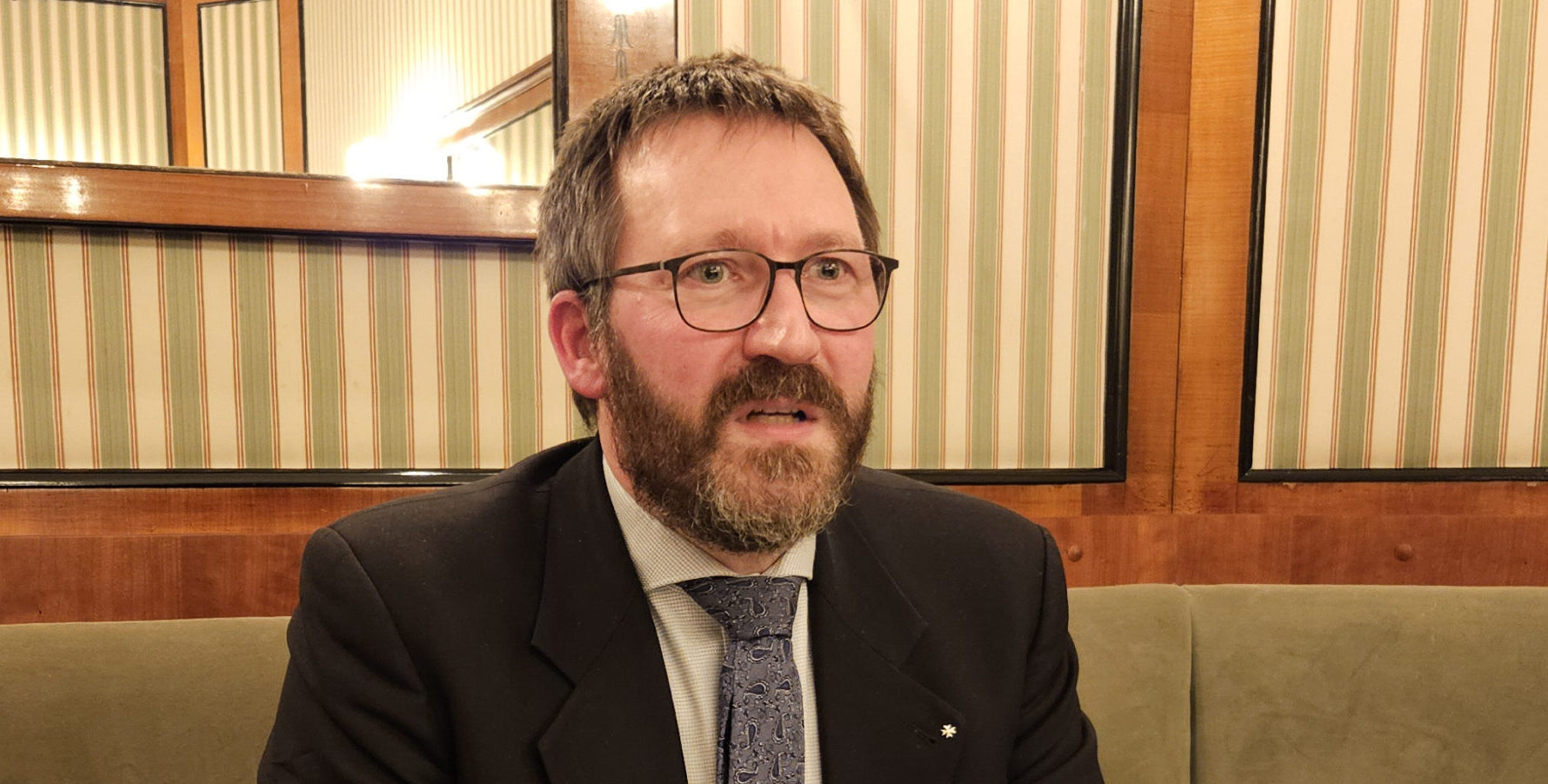
The CPCE invited Austrian media representatives to a background meeting with Secretary General Mario Fischer. The meeting was very positive and featured numerous questions from the attending journalists, most of whom have a Catholic background. They expressed strong interest in the European Protestant church landscape and its many voices and faces.
Unlike the Catholic Church, the Protestant tradition does not claim to impose a single line from above. Since the theological dialogues of the early 1970s, Lutheran and Reformed theologians have sought to come together. The goal has always been to understand the positive aspects of each other’s tradition, without dismissing or rejecting them from the outset.
As a result, there is no single voice for the Protestant churches, even though the GEKE initially aimed to represent a unified Protestant voice in Europe. Mario Fischer explains:
“We have somewhat moved away from that, because the churches often have very different perspectives on socially sensitive issues such as migration or ethical questions regarding gender and sexuality. There is an ethical corridor within which multiple positions are possible. This became particularly clear during our process on assisted dying. What we aim for is to empower our member churches to speak in their respective contexts, based on our studies and research, so they can form well-informed opinions.”
Location in Vienna and CPCE’s History
The CPCE has had its headquarters in Vienna since 2007, even though only 3–4% of Austrians are Protestant. The location was chosen, Fischer emphasized, “to be positioned as a bridgehead in Europe after the fall of the Iron Curtain.”
Originally, the CPCE office was located wherever the Secretary General served part-time—first in Strasbourg, then Berlin, and finally Vienna. The Leuenberg Church Fellowship in Strasbourg initially consisted essentially of a mailbox, where churches wishing to join could send their applications. Today, the GEKE is well established with a team of new staff. Regarding its public presence, Fischer notes: “We have succeeded in making it clear that we are one church. Reformed believers can attend services in Methodist, United, or Lutheran churches while on vacation. We also represent the churches to European institutions.”
Challenges in Europe
Fischer observes a growing hardening of political positions in Europe: “There are hardly any binary decision-making processes left. Many only accept A or Not-A, while B, C, or D are often ignored. This was evident during Brexit, but also in several European countries, where churches are partially politically co-opted. For example, the Hungarian Reformed Church is strongly influenced by massive financial support from the Orbán government.”
Despite differing views within the church community, dialogue remains essential. A particularly notable moment was the 2024 General Assembly, where Ukrainian and Russian representatives of the local Lutheran church sat together on the podium and discussed the diverse roles of churches in the war.
Protestant Minority Churches in Europe
Protestant churches are often in the minority in Europe. Of approximately 500 million Europeans, about 40 million are Protestant, including 20 million in Germany. In Scandinavia and Iceland, the population remains predominantly Protestant, but overall numbers are declining. Many congregations have become sparsely populated, prompting new initiatives such as “Mixed Economy” projects to foster forms of community beyond traditional structures.
Even in the outskirts of Europe, small Protestant congregations have drastically declined due to labor migration. The churches aim to remain present both for those who have moved away and for new migrants who have recently arrived.
Fischer concludes: “Our societies are God’s field. There, we want to act and proclaim the message of the Gospel.”