
One of the strategic tasks of the CPCE for 2024–2030 is to promote open pastoral training programs. However, this remains a challenge, as pastoral training in member churches is typically local in character.
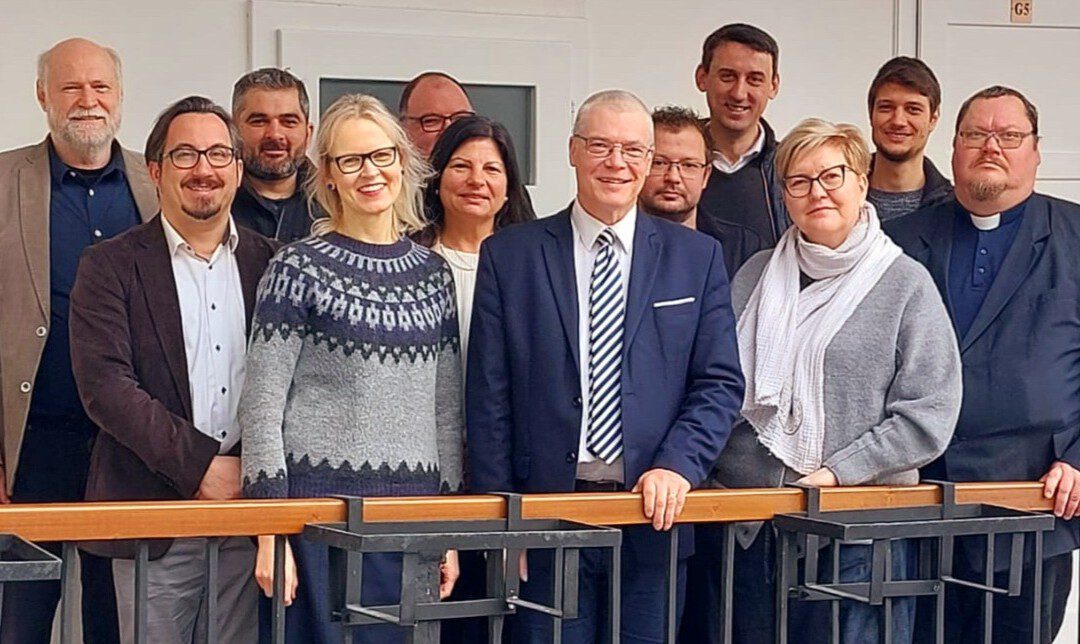
To address this, the ordinands training programs of the Estonian Evangelical Lutheran Church and the Evangelical Church of the Augsburg Confession in Romania have launched a pilot model for short, cross-border training days. On March 28–29, 2024, ordinands from both churches gathered in Sibiu/Hermannstadt, accompanied by their trainers, Bishop Marko Tiitus and Dr. Stefan Cosoroaba. Their discussions focused on how to pass on the faith to future generations.
A key reference point for their exchange was the ‘Bucharest Mission Code,’ developed by The Centre of Protestant Theology in Eastern Europe (ZETO), which had inspired Estonian ordinands to create a ‘Tallinn Mission Code.’ Comparing these two approaches highlighted the critical role of context in shaping mission work. As a result, participants concluded that there is no such thing as ‘instant’ mission. However, one principle remains universal: mission must never be driven by fear (Bucharest Mission Code, XVI). As Christian churches, we have something essential to offer society.
The participants also compared their respective training programs. In Estonia, the training program lasts one year, with a strong emphasis on personal development. Training is voluntary, and most ordinands enter the program after years of experience in other professions. In Romania, training lasts two years and is supported by employment within the church. Most Romanian ordinands transition directly from university into their training phase.
This initiative raises some fundamental questions about the possibility of pastoral training unites within the CPCE network. Can ordinands and pastors in their early years of service be considered a reliable target group for such programs? Should these exchanges remain bilateral, or can they be expanded to include multiple churches? Finally, is it worthwhile for churches to invest financially in such cross-border training? Feel free to contact us if you have any answers to these questions or would like to share your thoughts on the topic.
The initiative was made possible thanks to the encouragement and financial support of ZETO, to whom gratitude is expressed.